Recursion in C: trace calls, returns and local variables
Trace a recursive C function step by step: printf order, separate copies of n, the base case, and why n - 1 and --n produce different return output.
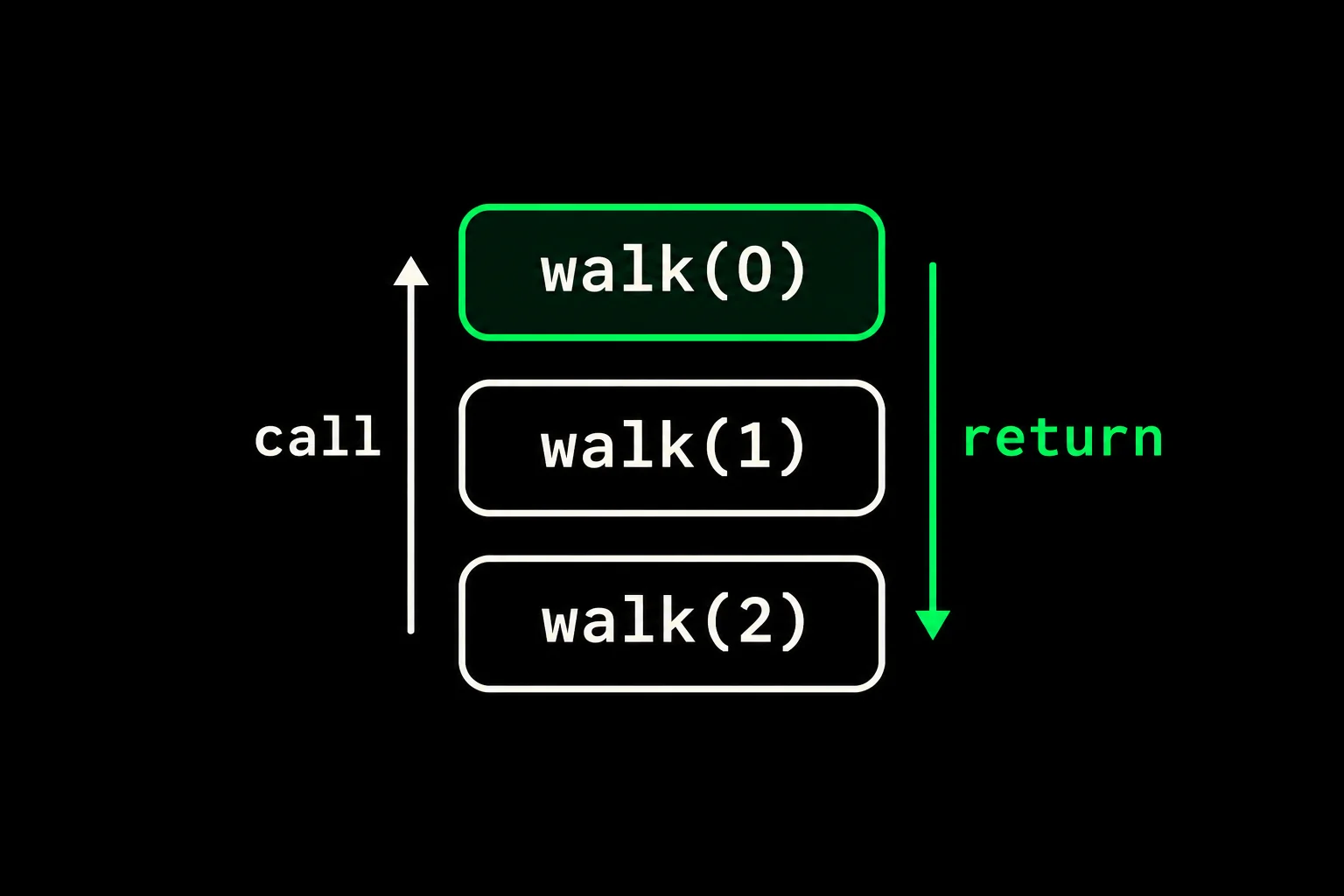
You put a printf after a recursive call and the numbers come out in reverse order. Yet there's no loop counting upward. To explain the output, you need to keep track of the calls that haven't finished.
In short
In a recursive C function, code before the call runs on the way down, and the caller then waits for that call to finish. Code after it resumes on the way back up, from the innermost completed call toward the first. Each call has its own parameter n: passing n - 1 doesn't change the caller's n. The base case stops further calls; its return gives control back to the immediate caller.
In what order do the printf statements run?
The first printf runs before descending; the second waits for walk(n - 1) to return. This program is short enough to follow line by line.
#include <stdio.h>
static void walk(int n){    if (n <= 0) {        printf("base %d\n", n);        return;    }    printf("before %d\n", n);    walk(n - 1);    printf("after %d\n", n);}
int main(void){ walk(2); return 0;}$ gcc -std=c17 -Wall -Wextra -Werror -O0 -g walk.c -o walk$ ./walkbefore 2before 1base 0after 1after 2walk(2) prints before 2, then calls walk(1). Its last printf still needs to run. walk(1) does the same with walk(0). That call reaches the base case and returns, allowing walk(1) to print after 1 and finish. Finally, walk(2) resumes and prints after 2.
The phrase "on the way back up" describes this return order. Execution doesn't rewind the lines that already ran or restart the function from the beginning.
Which call is active at each step?
Only one call in our program executes an instruction at a time. The others are waiting or have already finished. Each snapshot below is taken just before the printf shown in next; the cells keep the same identity throughout the trace.
Step 1 of 5
Before printing before 2
- n
- 2
- next
- before 2
- walk(2)n = 2active
- walk(1)not calledpending
- walk(0)not calledpending
walk(2) has passed the n <= 0 test. It will print before 2, then call walk(1).
Read all steps
1. Before printing before 2
- n
- 2
- next
- before 2
- walk(2)n = 2active
- walk(1)not calledpending
- walk(0)not calledpending
walk(2) has passed the n <= 0 test. It will print before 2, then call walk(1).
2. Before printing before 1
- n
- 1
- next
- before 1
- walk(2)n = 2waiting
- walk(1)n = 1active
- walk(0)not calledpending
walk(1) received its own value 1. walk(2) waits for this call to return; its n is still 2.
3. Before printing base 0
- n
- 0
- next
- base 0
- walk(2)n = 2waiting
- walk(1)n = 1waiting
- walk(0)n = 0active
walk(0) reaches the base case. It will print base 0 and return only to walk(1).
4. Before printing after 1
- n
- 1
- next
- after 1
- walk(2)n = 2waiting
- walk(1)n = 1active
- walk(0)finishedreturned
walk(0) has finished. walk(1) resumes after walk(n - 1), with its own n still equal to 1.
5. Before printing after 2
- n
- 2
- next
- after 2
- walk(2)n = 2active
- walk(1)finishedreturned
- walk(0)finishedreturned
walk(1) has finished too. walk(2) resumes with n equal to 2 and will then return to main.
Cells marked "finished" retain the history. They no longer represent accessible variables in an active function call.
Why does n become 1 and then 2 again?
Those values were never overwritten. The expression n - 1 computes an argument for the next call without assigning anything in the caller. At the base case, the calls to walk have three distinct instances of the parameter:
Stack
- intn
- 0
- intn
- 1
- intn
- 2
This diagram shows the walk calls, leaving out main and library frames. The call stack is a useful model for keeping track of pending work. Machine frame details can change with optimization; the observable order of this program still follows its statements.
A static local variable would be shared across calls. The parameter int n here isn't static. For the connection to object lifetime, see Stack and heap in C. The explanation of passing values and pointers also covers why changing an ordinary parameter doesn't directly change the caller's variable.
What changes if walk(n - 1) becomes walk(--n)?
--n first decreases the current call's parameter and then passes that value to the next call. The descending arguments are still 1 and 0, but the waiting calls have changed their own n too. Replace just that expression to see the difference:
$ sed 's/walk(n - 1)/walk(--n)/' walk.c > changed.c$ gcc -std=c17 -Wall -Wextra -Werror changed.c -o changed$ ./changedbefore 2before 1base 0after 0after 1In the modified version, the call that started with 2 has already decreased its parameter to 1 before waiting. The call that started with 1 has decreased it to 0. Their final printf statements therefore print 0 and then 1. Passing by value still works; the caller's expression has introduced a mutation.
Keep n - 1 when you want to pass a smaller value while preserving the current level for the return path. By contrast, n-- passes the value before decrementing it, so the next call receives the same positive number again. With our base case, that doesn't move the descent toward zero.
Why must the base case come before the next call?
It must prevent another call when the input is already a terminal case. Here, n <= 0 prints one base line and leaves the current call before any subtraction. Thus walk(0) prints only base 0, and walk(-1) prints only base -1.
For a positive input, n - 1 moves each call closer to zero. Both properties matter: a stopping case and progress toward it. Having a condition in the source isn't enough if the arguments move away from it.
The return in walk(0) doesn't leave walk(1) or main. It resumes the call site that invoked it. The work still pending in the parent calls accounts for the after lines.

descend
Turn this traversal into notifications in descend: call on_enter on the way down and on_leave on the way back up. Your function must not print, and either callback may be NULL. Its base case produces no notifications, unlike the base line in our demonstration.
How can you trace another recursive function on paper?
Record each call separately, including its arguments and the next instruction to execute when it resumes. Stop descending at the base case, then finish the most recent call first. Add an output line only when execution reaches its statement.
For walk(3), predict the output before changing main: before runs from 3 down to 1, followed by base 0 and after from 1 up to 3. Check it in the visualizer or with gdb(1). If a function contains several recursive calls, record which call comes next as well; a column of values alone no longer captures the pending work.
Frequently asked questions
Can a void function be recursive?
Yes. void means it returns no value, not that it never returns control. Our function prints lines and then returns to its caller.
Do parent calls keep running during the child call?
Not in this sequential program. The caller waits for the child to finish before executing the next statement. Recursion doesn't create a thread.
How many calls does walk(2) make?
There are three calls to walk in total, with 2, 1 and 0. For a positive input n, this version makes n + 1 calls. The base case counts as a call even though it makes no further one.
Does a base case prevent every stack overflow?
No. A descent can be finite yet too deep for the available stack. C has no portable maximum recursion depth. For a large input, consider a loop or an explicit stack; don't rely on tail-call optimization to guarantee safety.
Sources